


Everyday work
Simple tables
Collect each delimited field into a numbered text block.
Extract columns from delimited text by choosing a delimiter (comma, space, or any valid character)
Read a simple delimited table and collect each column into its own labeled text block.
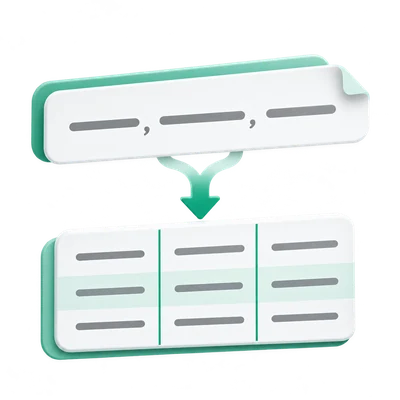
Collect each delimited field into a numbered text block.
Read one column at a time while retaining row positions.
Separate consistent plain-text rows before another text operation.
A comma is the initial delimiter.
The tool splits rows literally on the Delimiter value, determines the largest column count, and emits one numbered block per column. Each block contains that field from every row. Missing fields contribute empty lines, preserving the row positions in the column block.
Choose the options before applying the transformation.
Column separator: initially ",".
A short input makes the transformation easier to inspect.
This example was checked with the current tool. The options shown apply only to this example; your editor keeps the settings you select.
Ada,London,42
Lin,Paris,37
------ [ 1 ] -------
Ada
Lin
------ [ 2 ] -------
London
Paris
------ [ 3 ] -------
42
37
Upload a text file, write directly, or try the sample.
The entry screen accepts one UTF-8 TXT, CSV, JSON, XML, HTML or HTM file and opens the editor. Imports are text content, not a PDF or Word conversion. Review the source and choose Split Text into Columns when ready. Editing or importing alone does not apply the transformation.
Check the report before saving or continuing with the text.
Result overview displays the original row structure as a table, with Rows, Columns and Rows with missing columns. The editable TXT result still uses numbered column blocks; CSV keeps the row-and-column table structure. Select TXT for the editable text or CSV for the full table, then use the download icon. Editing the result hides the table and disables CSV until you rerun the tool; TXT and copy still use your edits. Continue to offers compatible next tools for the current text and their limits. Review the transferred text before running the next operation.
Maximum input and editable TXT result: 1 MB of UTF-8 text, with a 1,048,576-character input ceiling. Expanding transformations must also fit the TXT result limit. CSV files can be larger because they include column headings, quoting and separators. The table shows 50 rows per page and at most 12 columns. Long cells are shortened after 160 Unicode code points on screen; CSV retains all rows, columns and complete values. Splitting stops if the number of input rows multiplied by the widest row's column count exceeds 1,048,576.
This text operation runs in your browser; its source and result are not sent for conversion. A draft may be kept in this browser tab when session storage is available. Clear removes the current draft; download important work before closing the tab.
See the Privacy Policy for file and data handling.
No. This tool processes text in your browser. Text-file imports and downloads stay on your device.
Yes. The result remains editable. Copy it or download a UTF-8 .txt file from the result page.
Text input and generated output are limited to 1 MB to keep your browser responsive. Split larger documents into smaller parts.