


Read a simple delimited table and collect each column into its own labeled text block. Follow the exact input and settings below to reproduce this example. Open Split Text into Columns.
Prepare the source text
Open Split Text into Columns and choose Write or paste text, or upload a supported UTF-8 text file. The upload opens the editor; it does not run the tool. This example uses the exact source shown in the comparison.
Maximum input and editable TXT result: 1 MB of UTF-8 text, with a 1,048,576-character input ceiling. Expanding transformations must also fit the TXT result limit. CSV files can be larger because they include column headings, quoting and separators.
Use the exact example input
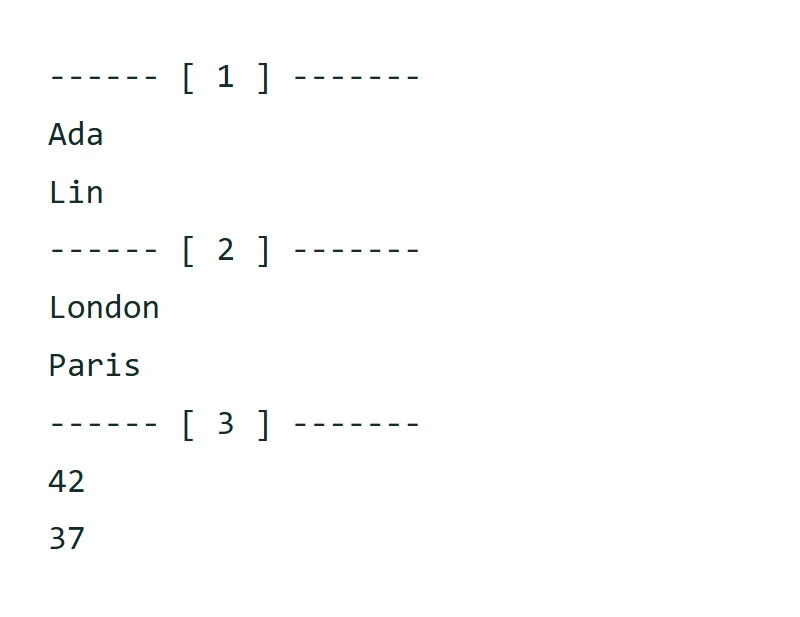
Ada,London,42
Lin,Paris,37
This text operation runs in your browser; its source and result are not sent for conversion. A draft may be kept in this browser tab when session storage is available. Clear removes the current draft; download important work before closing the tab.
Choose the settings
For the recorded example, use these settings: Column separator: ,.
The tool splits rows literally on the Delimiter value, determines the largest column count, and emits one numbered block per column. Each block contains that field from every row. Missing fields contribute empty lines, preserving the row positions in the column block.
The example in this guide
Verified in the i2TEXT browser workflow on November 11, 2026.
- Input
- example.txt
- Output
- split-text-into-columns.txt
- Saved result
- 89 bytes
Apply and inspect the result
Select Split Text into Columns when the input and settings are ready. In the saved example, the result begins: "------ [ 1 ] -------".
This is not a full CSV parser: quoted delimiters and embedded quoted newlines are not interpreted. Use it for consistently delimited plain text.
Result overview displays the original row structure as a table, with Rows, Columns and Rows with missing columns. The editable TXT result still uses numbered column blocks; CSV keeps the row-and-column table structure.
Result overview distinguishes changed, unchanged and empty results. An unchanged result means the selected operation did not alter the text; an empty result can be the expected outcome of removal or extraction. The table shows 50 rows per page and at most 12 columns. Long cells are shortened after 160 Unicode code points on screen; CSV retains all rows, columns and complete values.
Save the version you reviewed
Review the table and choose TXT or CSV beside the download icon. TXT saves the editable result as split-text-into-columns.txt; CSV saves the complete table as split-text-into-columns.csv, including data beyond the visible preview. Choose TXT for numbered column blocks or CSV to keep each record on a row. Continue to offers compatible next tools for the current text and their limits. Review the transferred text before running the next operation.
CSV describes the last conversion, so editing the result hides the table and disables CSV until you rerun the tool. Copy and TXT download still use your edited text. Formula-like CSV values receive a leading apostrophe to prevent spreadsheet formula execution.
example.txtsplit-text-into-columns.txt
Common questions
Which settings produced this example?
Column separator: ,.
What should I check before using the result?
This is not a full CSV parser: quoted delimiters and embedded quoted newlines are not interpreted. Use it for consistently delimited plain text.
Where is this text processed?
This text operation runs in your browser; its source and result are not sent for conversion. A draft may be kept in this browser tab when session storage is available. Clear removes the current draft; download important work before closing the tab.
Try Split Text into Columns with your own text.
Use your own source and review the result before sharing.